Participants will receive 3 credits of Animal Science 400 or Dairy Science 400 upon successful completion of the course.
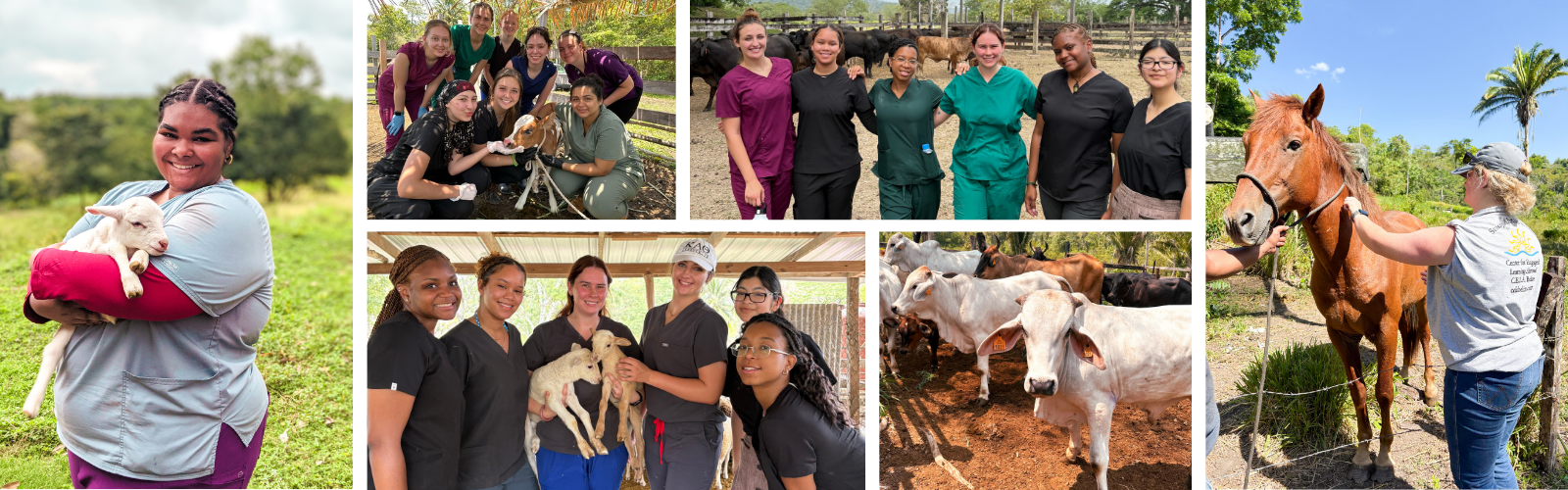
Students take one course on this program where they will develop a basic understanding of the role of livestock in agriculture (Belize and globally). The course goal is to expose students to the practice of farm animal medicine and the production systems involved. It will introduce basic concepts and principles of animal nutrition, growth, health, behavior, reproduction, and genetics, as well as practical commercial applications, such as ration formulation, disease prevention, artificial insemination, genetic selection, and crossbreeding systems. Labs and field trips to a variety of farms in the area provide opportunities to gain practical experience and a better understanding of the lecture material.
Course Equivalents
Use the links below to see a list of courses that past students have taken
on this program and the UW equivalents. Note: This list only includes
pre-approved courses for your program and may not be an exhaustive list of
courses, departments or equivalents. Courses may not be available the
semester you are abroad. You will receive instructions on the course
equivalent process after acceptance.
View Course Equivalents
Location
San Ignacio is located in west-central Belize and serves as the cultural-economic hub of Cayo District. It has ~17,000 inhabitants. Nearby attractions include the ancient Maya ruins of Caracol, Xunantunich, Cahal Pech, and El Pilar.
Belize has one of the most stable and democratic political systems in Central America. Belize’s small population is ethnically diverse and includes a large proportion of immigrants. English is the official language of Belize, but most of the population also speaks a creole patois, and many Belizeans are multilingual. Yucatec, Mopán, and Kekchí are spoken by the Maya in Belize. Mestizos speak Spanish, and the Garifuna speak an Arawak-based language and generally also speak either English or Spanish. The Mennonites in Belize speak Plautdietsch, an archaic Low Saxon (Germanic) language influenced by the Dutch.
Situated south of the Yucatán Peninsula, Belize is a land of mountains, swamps, and tropical jungle. It is bounded by Mexico to the north, Guatemala to the west and south, and the Caribbean Sea to the east. The country has a 174-mile (280-km) coastline.
Housing
Participants are provided with housing in a guesthouse or similar lodging in San Ignacio. Participants share a room with another student on the same program. All housing has potable water provided, breakfast on-site, hotel front desk, and Wi-Fi. Housing either has en suite bathrooms or shared bathrooms in the same building. Rooms will only be shared with program students, but other individuals (not related to the program) may be staying in the same building and sharing common areas. All rooms have a lockable door.
Breakfast and a few lunches are included, but most dinners and all weekend meals except for breakfast are not. There are many affordable restaurants within walking or short taxi distance from the housing.
Program Considerations
In a physical sense, the on-site experience may be very different from life on the UW campus. You may walk or take public transportation more than you are used to in Madison. The physical activity level will vary by program, but in general you should be prepared for extended periods of time walking, potentially on uneven terrain.
For many students, discovering and experiencing new foods is a part of the experience. It is important to consider any dietary restrictions, whether they are due to health conditions, religious beliefs, or individual needs, and look into whether you can get the foods you need locally.
How you identify yourself in Madison may differ from how people will view you on-site. Consider exploring our Identity Resources to reflect on how your identities may impact your experience. Students with disabilities should keep in mind that attitudes and laws related to disabilities vary by country, and these differences may impact the level of accommodation available in a particular location. More details are available on our page on Study Abroad for Students with Disabilities.
We encourage you to contact your Study Abroad Advisor and share your accommodation needs with us as early as possible. This will allow us to help you explore your options in advance.
- Participants spend time on working ranches and farms where it is crucial to follow instructions of the veterinarian in charge and adhere to safety protocols for the health of the animals and people involved
- Extended physical activity or lifting may be required
- Air conditioning may not be available in housing or program sites
Excursions and Activities
Activities provided and included during the program include spending time on farms in close proximity to large animals such as horses, cows, goats, and pigs. Horseback riding is sometimes available. Participants may be using or near to farm equipment or medical equipment, and may use needles and other sharp items. Program includes a small animal surgical clinic with animals from the surrounding area.
During their free time, participants are able in their free time to explore the city of San Ignacio and plan excursions, which could include the following:
- Explore a Maya site, learn about its history, and climb to the top of the pyramid overlooking the jungle
- Canoe in crystal clear waters of Barton Creek both inside and out of a cave
- Visit the beach for the day with optional snorkeling
- Learn about the conservation efforts for Green Iguanas in San Ignacio
- Learn about the ancient Mayan chocolate making process
On-Site Support
Dr. Edwardo Tesecum, DVM is the primary instructor of this course. Staff is available on-site 24/7 if a student has questions or needs support with a particular issue or help getting access to additional resources
Orientation
Prior to the program, students will receive update emails and have access to the CELA Belize current student site, which contains info about flights, packing lists, rules, weather, money, etc. One week before travel, students will receive the names and contact info of the other members of their group. Two days before travel, students will receive the contact info for the individuals picking them up at the airport in Belize, including a photo.
Upon arrival in Belize, students will have an in-person orientation and welcome dinner, where they will get to know one another and their staff, and go over the safety rules and expectations of the program, what to expect from their schedule, Belize culture, health and safety, introduction to the surrounding area, and contact information for their local staff.
Visa
A visa is not required for US citizens for this program. A visa is not required for passport holders from other countries who have a visa to live and study in the US.
US citizens must have a US passport valid for at least six months beyond the end of the program.
Ask your Study Abroad Advisor, if you have any questions.
Getting to Your Program
You are responsible for arranging round-trip transportation to the program site. Two days before travel, students will receive the contact info for the individuals picking them up at the airport in Belize, including a photo.
Insurance
You will be enrolled in the UW System required health insurance through Cultural Insurance Services International (CISI) and the cost of the insurance coverage is included in program fees.
If you are a citizen of a country other than the United States and will remain/study in, or travel to your country of record (the location of your permanent residence), the insurance provided for you is the same as the “study away” insurance provided to U.S. citizens studying on domestic U.S. programs. You may want to explore alternative or additional international health and medical insurance that will cover your needs both while in and during any period of transit to/from your country of record. This may include participation in a national healthcare plan or coverage provided under a personal healthcare plan in your country of record. If you have questions about the coverage of the “study away” plan, please speak with your Study Abroad Advisor.
All other students participating on an international program will automatically be enrolled in Cultural Insurance Services International (CISI), the university's international health, medical and repatriation insurance policy.
Program cost information includes program fees, as well as out-of-pocket expenses with notes to help explain costs. Program fees are estimated and can be adjusted at any time. Once accepted, you will receive a cost sheet that includes confirmed program fees and additional out-of-pocket expenses. "The IAP Program Fee" and all processes and policies stated on this cost sheet apply to all participants on programs managed by International Academic Programs (IAP) and in partnership with the College of Agricultural and Life Sciences, the College of Engineering, and Wisconsin School of Business. All students participating on approved programs are all eligible to apply for scholarships administered through IAP when they meet the scholarship eligibility and selection criteria.
Winter Intersession 2026-27 Cost Details
Summer 2027 Cost Details
Financial Aid
UW–Madison students can typically use their financial aid on UW–Madison study abroad, domestic study away, and international internship programs. You need to complete a FAFSA if you want to be eligible to receive federal and state financial aid.
Beginning in 2026-27, the Office of Student Financial Aid will require all incoming undergraduate students to submit a CSS profile.
Review our financial aid and funding your experiences pages for more information.
Scholarships
Check out our scholarships page to find:
- A scholarship chart listing internal and external opportunities, with descriptions, deadlines, and amounts.
- Timelines of when UW-Madison study abroad scholarship applications open and close.
- Tips for writing scholarship essays.
Find scholarships
Program Scholarships
This scholarship list includes scholarships we know are relevant to this program. It is not an exhaustive list of all available scholarship opportunities for study abroad. Although we make our best effort to ensure the list is up-to-date, this information changes frequently, and it is the responsibility of the applicant to verify information. For additional scholarship information, please visit our scholarship page.
IAP Administered
Bryan Davia Scholarship
IAP Study Abroad Scholars
IAP WISc Scholarship
National
Social, Environmental, and Economic Development (SEED) Scholarship
Returned Student Network
View the Returned Student Network to contact a returned student
Student Quotes
"I went outside my comfort zone and I am so happy to have come to Belize. So beautiful and such amazing people!" - Katie B., CELA student
"CELA does a great job of helping you integrate into a new culture and gain an experience unlike any other!" - Melinda K, CELA student
Photos
Program photo album
How to Apply
First, make sure you have reviewed the information for Prospective Students on the IAP website.
There is also specific Academic Planning information that you should review.
Next login to the IAP Online Application.
Wondering when applications will open for this program?
View our application schedule.
After the Deadline
IAP completes a review of all applications to determine if students meet minimum eligibility requirements.
| Session |
Application Status |
| Winter Intersession 2026-27 |
Application Closed |
| Summer 2027 |
Apply Now
|
Disclosure
Students Requiring Accommodations: Consult and register with the McBurney Disability Resource Center McBurney Services if you will need academic, housing, and/or other disability-related accommodations or services abroad.
International Students: Talk with International Student Services about your visa status and study abroad.
Military-Connected Students with Veteran’s Benefits: Talk with University Veteran Services about how your benefits can be used for study abroad.