Talk to a representative for this program at the Study Abroad Fair.
South Africa, Limpopo Province
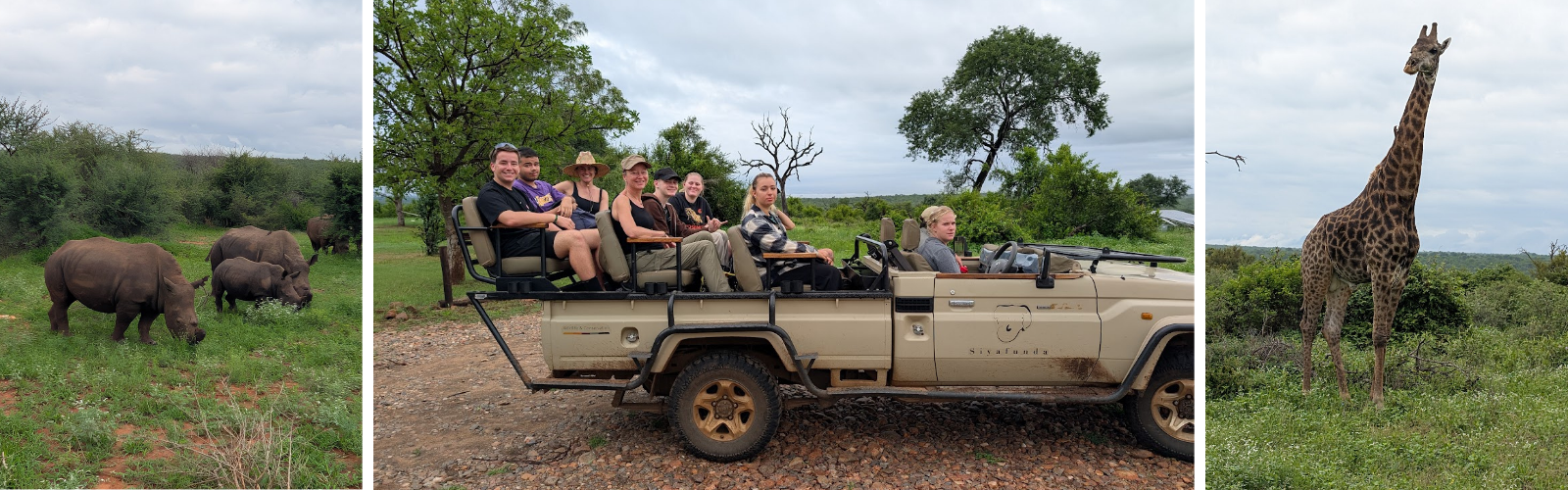
This two week study abroad program will focus primarily on the ecology and management of South African wildlife at a research station located in the Makalali Game Reserve in Limpopo Province, ending with a visit to Kruger National Park. Students will participate in daily wildlife monitoring drives and bush walks to collect and analyze data that inform management decisions for the reserve. Through lectures and field activities, students will learn about ecology and behavior of African wildlife as well as wildlife conservation issues, such as nature reserve management, impacts of wildlife-based tourism, community involvement in conservation, and wildlife crime. Students will also engage in habitat restoration.
Through hands-on fieldwork, data collection, analysis, and habitat restoration alongside full-time rangers and conservationists, students will build their practical skillset; learn about local and global wildlife ecology challenges; discuss conservation issues and strategies; and learn about potential career paths.
Program activities and excursions include:
• Morning and late afternoon wildlife monitoring drives or bush walks
• Lectures by research station staff, biologists, and wildlife experts
• Habitat restoration and reserve maintenance work
• Exposure to data analysis, camera trap work, or other projects
• Excursion to Blyde River Canyon
Watch an info session with Program Leader Jim Berkelman:
Check out the video transcript here.
Learning Objectives
We have overall Goals and Expectations for Study Abroad Participants, covering the personal, academic and professional aspects of study abroad. Additionally on this program, you can:
1. Describe how ecological principles such as carrying capacity, niche differentiation, trophic cascades, and ecological succession apply to the wildlife and ecosystems of southern Africa.
2. Discuss how the size and structure of wildlife populations can change over time based on both environmental factors and interactions among different species.
3. Evaluate interspecific interactions, including competition and predation and explain how they impact ecosystems using southern Africa as an example.
4. Describe how habitat and landscape features impact wildlife populations and how these features can be altered or managed to improve conditions for wildlife.
5. Describe the goals and strategies that wildlife managers use in southern Africa and the challenges they face, including poaching and anti-poaching initiatives.
6. Communicate with local communities and scientists to understand the stakeholder viewpoints that are important to wildlife management decisions.
7. Gain exposure to the use of field techniques used to monitor wildlife populations, which may include activities like tracking, radio telemetry, and camera trap deployment.
8. Identify commonly observed wildlife species of southern Africa and be able to explain their taxonomic relationships
Diversity & Inclusion
We are committed to providing quality study abroad and domestic study away programs for every UW-Madison student. We work strategically to identify, address, and remove barriers that may prevent participation and to provide a welcoming and inclusive environment for students. Our staff actively engages with students, faculty, and staff from diverse backgrounds and prioritizes the continuous development of our knowledge and cultural competence. We also recognize the importance of increasing access to study abroad for historically underrepresented student populations. We are committed to diversity and inclusion so that every student can engage with and understand their identity through a new lens and continue to develop and make progress on their personal, professional, and academic goals.
Sustainability
We recognize that the future of study abroad, domestic study away, and international internship programming requires a Commitment to Sustainability. We are devoted to examining, developing, and improving sustainability in all our endeavors, aligning with campus priorities and following through with UW-Madison's climate action and Resilience Commitment. Join our efforts and learn more about how to study abroad sustainably.
Request Information
Join our email list to receive program updates-including application notices, scholarship information, and more!
Eligibility
- Preference given to students in the Wildlife Ecology major and/or in CALS
- Preference given to students with Junior or Senior standing
- Preference given to students who have taken a course in ecology or conservation (e.g., Bot/Zoo 260, F&WE 318, F&WE 360, Envir St 339, or Bot/Zoo 460)
- 2.0 cumulative GPA
- Sophomore, Junior, Senior
- Open to UW-Madison degree-seeking students only
- Good academic and disciplinary standing
- At the time of application and the semester prior to participation, UW-Madison students must be currently enrolled. Transfer Students to UW-Madison need to be currently enrolled at their home institution
Advising Location

Program Structure
UW Signature
Subjects
Wildlife Ecology, Environmental Studies, Animal Management, ConservationClassroom Language
English
Housing
Field Research Station
Program Duration
Mid-May to late MayApplication Deadline(s)
| Summer 2026 | 2/6/2026 | Cost Details |
| Summer 2027 | 12/4/2026 | Cost Details |
Future durations will be posted at a later date.
APPLY NOW
Students will earn two credits of Forest & Wildlife Ecology 375: Wildlife Conservation in South Africa upon successful completion of the two-week program in South Africa. Assignments include an African wildife species report, African wildlife species presentation, daily journal entries, lecture reflections, and participation in course activities.
This course can count as a major elective in the "Conservation" category for the Wildlife Ecology major. See your academic advisor about using the course to meet requirements for other majors.
Course Equivalents
Use the links below to see a list of courses that past students have taken on this program and the UW equivalents. Note: This list only includes pre-approved courses for your program and may not be an exhaustive list of courses, departments or equivalents. Courses may not be available the semester you are abroad. You will receive instructions on the course equivalent process after acceptance. View Course Equivalents
Program Leader
Jim Berkelman
Program Leader, Forest & Wildlife Ecology
Dr. Berkelman teaches undergraduate Wildlife Ecology courses at UW-Madison and previously led a two week study abroad program on Wildlife Ecology in Mexico.