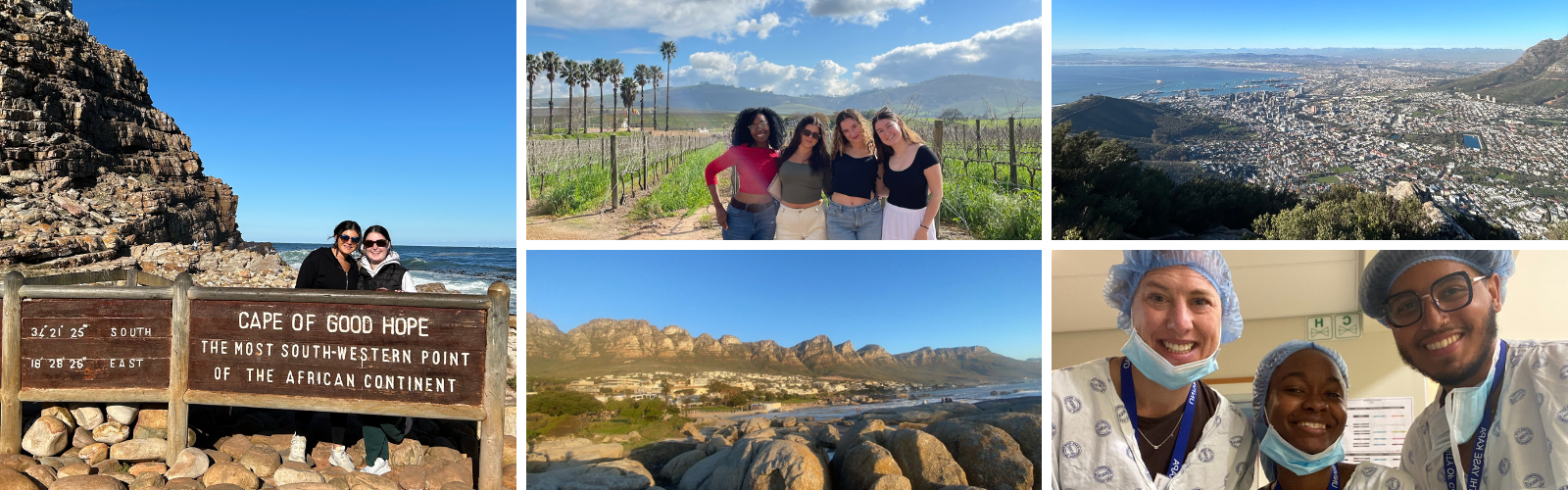
South Africa, Cape Town
CFHI provides students on this five-week program with unique opportunities to learn about global health from experts and practitioners while embedded in existing health systems in Cape Town, South Africa. Participants engage in hospital rotations, shadowing local medical or public health professionals at either a Secondary Teaching Hospital or in the trauma unit of a large Children's hospital.
South Africa is known as the rainbow nation, a multi-cultural and multi-lingual melting pot. A nation where over 12 different languages are spoken and where South Africans of European, black, white, Indonesian, Indian and various mixed race descent interact. The diversity and openness one sees today sits in stark contrast with the oppressive history of a government system of racial oppression known as “Apartheid”. While official segregation no longer exists, race is still the most important factor affecting where people live, the type of job they have and the quality of government services they are able to access, such as quality education, infrastructure, sanitation and healthcare.
Travel to Cape Town, known as the “mother city”, and one of South Africa’s most beautiful cities. Cape town is the second most populous city in South Africa. Multicultural and diverse, this will be the stage for a first-hand experience of the daily challenges faced by its recently created healthcare system, where students will shadow and learn from local healthcare personnel in public district hospitals providing care for the underserved.
Since the fall of Apartheid, South Africa has taken great strides to bridge the wide economic and social gap that was left with Apartheid. Infrastructure, education, healthcare services and economic opportunities have grown. The majority Black population had limited or non-existent healthcare until the 1990s and today South Africa’s healthcare system provides free or low cost care to most of its population. Yet, besides these great strides, South Africa was one of the hardest hit countries by one of the worst pandemics in recent history, overburdening a fledgling system that was just starting to provide basic services to the majority of the population who had little to no access to them. The legacy of Apartheid, poverty, continuing inequality and the lack of knowledge and misconceptions about HIV/AIDS, and other factors.
Adding to the cultural language immersion, live with local families in the Cape Flats area, a racially diverse great urban expanse behind Table Mountain, populated by forced government relocations during the Apartheid era. CFHI participants may also organize weekend trips from Cape Town to the world-famous Paarl and Stellenbosch wine country, or travel on the well-known Peninsula tour circuit to visit Cape of Good Hope Nature Reserve, home to a colony of African penguins.
CFHI provide trainees with a unique opportunity to engage closely with local health professionals, fostering meaningful connections and gaining valuable insights into diverse healthcare systems. Trainees are placed in existing healthcare settings under the mentorship of experienced preceptors. The programs emphasize ethical global health engagement, allowing participants to develop critical global health competencies. These include a comprehensive understanding of the host country’s healthcare systems, analysis of morbidity and mortality trends, and the enhancement of intercultural humility and communication skills. Through participant-observation, trainees integrate within local teams, deepening their commitment to global health ethics and best practices.
Clinical Rotations & Public Health Placements
Participants in this program will be placed either at a Secondary Teaching Hospital or in the trauma unit of a large Children's hospital. When applying, please indicate preference between the two hospitals based on the descriptions below. CFHI will do its best to accomodate rotation preferences, though all students should be aware that they may be placed at either hospital.
Secondary Teaching Hospital- This secondary hospital falls under the Provincial Health Department and the University of Cape Town. The hospital has 158 inpatient beds and serves a population of approximately 47,000 per year. 50% of their patients are uninsured, and are served at low cost, and they also see patients with private insurance. CFHI participants will rotate in the Internal Medicine department. Pediatric Department rotations may also be available. Each of these departments has a department head physician who will act as preceptors for the CFHI program. Because students will be rotating at one facility, students have an excellent opportunity to develop a familiarity and rapport with Victoria Hospital's patients and staff. This allows participants to get a more in-depth understanding of the complexity of South Africa's healthcare system in the context of this secondary hospital.
Children’s Hospital: Trauma Unit- This Children’s Hospital’s principal task is to provide care to the children of Cape Town but also serves as a regional and national referral base for many specialties. The trauma unit has 2 operating theatres and the outpatient service 3 theatre. Childhood trauma will be the number 1 disease globally in 2020 according to the the World Health Organization (WHO), as reported in the third World Report on Child Injury Prevention in December 2008.
Trauma in children has become a major cause of mortality and morbidity, disability and a socio-economic burden. It is estimated that over 95% of all deaths due to injury in children occur in low- and middle-income regions and countries. Although the child injury death rate is much lower among children from developed countries, injuries are still a major cause of death, accounting for about 40% of all child deaths.
During their time at the trauma unit, participants will have the opportunity to witness the various medical techniques used in pediatric trauma, such as radiological imaging, total body digital imaging, emergency ultrasound and abdominal sonography for trauma , laparoscopic surgery, non-operative management of abdominal injuries and management of brain injuries, among many others. The hospital is also a leader in South Africa in promoting child safety in order to prevent injuries.
Learning Objectives
We have overall Goals and Expectations for Study Abroad Participants, covering the personal, academic and professional aspects of study abroad. Additionally on this program, you can:
-
Through ethical engagement with patients and populations, articulate the relationship between health and the social determinants of health.
-
Demonstrate an understanding of cultural and ethical issues in working with and learning within the context of underserved populations.
-
Outline assets, health needs, health challenges and inequities among different communities.
-
Recognize the barriers to health and healthcare delivery in low-resource settings.
-
Demonstrate a commitment to professional behavior while working collaboratively with health care team members and being respectful of differences in knowledge, practices, and culture.
-
Identify the major causes of morbidity and mortality affecting the populations across the world.
Diversity & Inclusion
We are committed to providing quality study abroad and domestic study away programs for every UW-Madison student. We work strategically to identify, address, and remove barriers that may prevent participation and to provide a welcoming and inclusive environment for students. Our staff actively engages with students, faculty, and staff from diverse backgrounds and prioritizes the continuous development of our knowledge and cultural competence. We also recognize the importance of increasing access to study abroad for historically underrepresented student populations. We are committed to diversity and inclusion so that every student can engage with and understand their identity through a new lens and continue to develop and make progress on their personal, professional, and academic goals.
Sustainability
We recognize that the future of study abroad, domestic study away, and international internship programming requires a Commitment to Sustainability. We are devoted to examining, developing, and improving sustainability in all our endeavors, aligning with campus priorities and following through with UW-Madison's climate action and Resilience Commitment. Join our efforts and learn more about how to study abroad sustainably.
Request Information
Join our email list to receive program updates-including application notices, scholarship information, and more!
Eligibility
- 2.5 cumulative GPA
- Sophomore, Junior, Senior
- Open to UW-Madison degree-seeking students only
- Good academic and disciplinary standing
- At the time of application and the semester prior to participation, UW-Madison students must be currently enrolled. Transfer Students to UW-Madison need to be currently enrolled at their home institution
Advising Location

Program Structure
Provider
Subjects
Global HealthClassroom Language
English
Housing
Local Hosts
Program Duration
Spring: Early February to mid-March (5 weeks)Summer June Session: Early June to mid-July (5 weeks)
Summer July Session: Early July to mid-August (5 weeks)
Sessions always begin on the first Saturday of the month.
Application Deadline(s)
| Summer 2026 - [June, 5 weeks] | 1/16/2026 | Cost Details |
| Summer 2026 - [July, 5 weeks] | 1/16/2026 | Cost Details |
| Spring 2026-27 | 10/2/2026 | Cost Details |
| Summer 2027 - [June, 5 weeks] | 1/15/2027 | Cost Details |
| Summer 2027 - [July, 5 weeks] | 1/15/2027 | Cost Details |
Future durations will be posted at a later date.
APPLY NOW
During the program, students are enrolled in International Studies 523: Culture and the Global Workplace course, an asynchronous 3-credit course you will complete while abroad with your Badger peers who are also interning around the world. The primary goal of the course is to provide students a processing space for the personal and professional cultural experiences they are having. The course is designed to complement your internship experience while encouraging you to think more critically about culture, identity, and other global issues, as well as your own experiences abroad. The course is discussion-focused (written) and includes sharing your own personal cultural reflections and engaging with your classmates regarding their own experiences. The IAP Intern Abroad team coordinates the course.
In the spring, students have the option to add 1-3 credits of directed/independent study with a UW-Madison faculty member. Students identify and set this up on their own and it must follow campus policy for directed study.
When adding a directed study or other coursework it is important to consider the many responsibilities you will have while abroad: a full-time internship, IS-523 online course, independent travel, etc. Intern Abroad staff strongly discourages enrolling in more than six credits.
Program Web Pages
Child Family Health International (CFHI) Cape Town Program
Course Equivalents
Use the links below to see a list of courses that past students have taken on this program and the UW equivalents. Note: This list only includes pre-approved courses for your program and may not be an exhaustive list of courses, departments or equivalents. Courses may not be available the semester you are abroad. You will receive instructions on the course equivalent process after acceptance. View Course Equivalents