This program will be offered next in Winter 2027-28.
India, Multiple
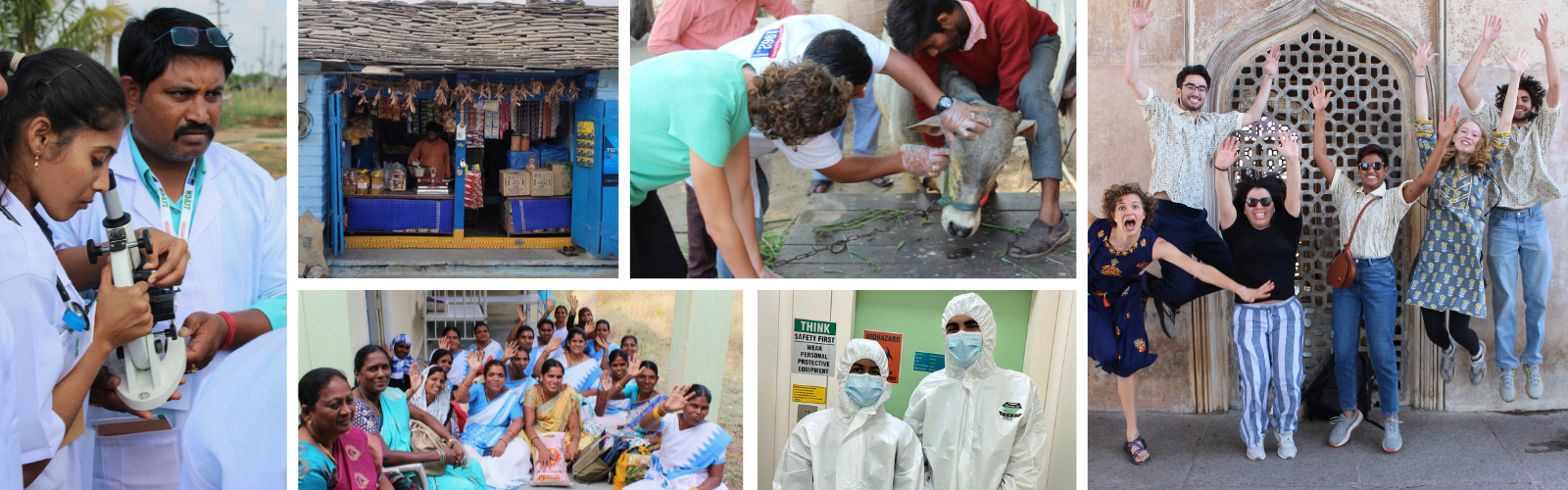
The UW Global Health Field School in India is offered in partnership between International Academic Programs and the UW-Madison School of Medicine and Public Health's Office of Global Health. On this two-week interdisciplinary experience you'll learn about and directly experience One Health issues as they apply to the Indian context. You will spend about 1 week at each of 2 host sites, EMRI Green and the NICE Foundation, in activities including small-group learning, community-based needs assessment, and visits to sites actively working in wildlife conservation and emergency medicine (both human and animal). You'll learn how public health, emergency care of humans and animals, and epidemiology are influencing one of the world’s largest human populations, their rural and urban domestic farm animals, and a wealth of rare and endangered wildlife. Because the Indian host institutions have training programs for Indian human and animal health professionals, you'll also have the opportunity to advance international cross-cultural understanding and collaboration.
This program is led by Ann Evensen, MD, FAAFP, Professor (CHS), Department of Family Medicine and Community Health, and Kurt Sladky, DVM, MS, Diplomate ACZM, Diplomate ECZM (Zoo Health Management & Herpetology), Clinical Professor.
The program will be supported in India by Authentica, a company specializing in travel management services for study abroad programs. Established in 2010, Authentica has delivered over 100 programs globally for 3000+ participants from various academic institutions across US, Canada, and Australia.
Learning Objectives
We have overall Goals and Expectations for Study Abroad Participants, covering the personal, academic and professional aspects of study abroad. Additionally on this program, you can:
Course Learning Outcomes:- Broadly define One Health in India and describe its application in unique cultural contexts in both rural and urban settings
- Describe issues related to shared zoonotic infectious diseases affecting humans and domestic and wild animals and how prevention and treatment measures might impact communities both in rural and urban areas and in communities adjacent to wildlife sanctuaries/parks.
- Explain the role that environmental factors—water sources, sanitation, habitat loss and deforestation—play in the health of human and animal communities
- Perform basic community needs assessments through accurate identification of key informants and stakeholders, and completion of common community data collection techniques (e.g., community health calendars, community walk throughs, photo documentation/Photo Voice, community mapping, etc.) to explore challenges/issues facing one or more rural or tribal communities.
- Explain the relationship between levels of the Indian health system (referral hospital, district hospital, community heath center, etc) and unique aspects of health professionals who work at each level of care.
- Describe the advantages and disadvantages of using grade/high schools can be a venue for health education and health assessment.
Diversity & Inclusion
We are committed to providing quality study abroad and domestic study away programs for every UW-Madison student. We work strategically to identify, address, and remove barriers that may prevent participation and to provide a welcoming and inclusive environment for students. Our staff actively engages with students, faculty, and staff from diverse backgrounds and prioritizes the continuous development of our knowledge and cultural competence. We also recognize the importance of increasing access to study abroad for historically underrepresented student populations. We are committed to diversity and inclusion so that every student can engage with and understand their identity through a new lens and continue to develop and make progress on their personal, professional, and academic goals.
Sustainability
We recognize that the future of study abroad, domestic study away, and international internship programming requires a Commitment to Sustainability. We are devoted to examining, developing, and improving sustainability in all our endeavors, aligning with campus priorities and following through with UW-Madison's climate action and Resilience Commitment. Join our efforts and learn more about how to study abroad sustainably.
Request Information
Join our email list to receive program updates-including application notices, scholarship information, and more!
Eligibility
- Graduate students/ Dissertators need to be in good academic standing. Undergraduate students require a 2.0 cumulative GPA.
- Open to Medicine, Pharmacy, Veterinary Medicine, MPH, Graduate, Capstone students, and Junior and Senior Undergraduates on a space available basis. Preference is given to students in Health Sciences and to Graduate students. It is recommended that students take Publ Hlth 714 (2 cr) during the Fall semester prior to the program.
- Junior, Senior, Graduate Student, Dissertator, MEDS, PHAR, VMED
- Open to UW-Madison degree seeking students and all degree-seeking undergraduate students at a US college or university. Preference is given to UW-Madison students
- Good academic and disciplinary standing
- At the time of application and the semester prior to participation, UW-Madison students must be currently enrolled. Transfer Students to UW-Madison need to be currently enrolled at their home institution
Advising Location

Program Structure
UW Signature
Subjects
Medicine, Vet Med, Pharmacy, Public Health, Global HealthClassroom Language
English
Housing
Hotels
Program Duration
Winter IntersessionApplication Deadline(s)
| Winter Intersession 2026-27 - [Suspended] | TBD | Cost Details |
| Winter Intersession 2025-26 | 8/29/2025 | Cost Details |
Future durations will be posted at a later date.
APPLY NOW
These students will earn credit for Public Health 716, a course that uses Sat/Unsat grading:
• Graduate/professional and capstone certificates students who are using the credit to fulfill certificate requirements
• MEDS who are not using the credit to fulfill certificate requirements
All other students will earn credit for Study Abroad 545: Topics in Social and Natural Science, which uses A-F grading.
A full course syllabus and schedule will be provided by your Program Leaders.
Course Equivalents
Use the links below to see a list of courses that past students have taken on this program and the UW equivalents. Note: This list only includes pre-approved courses for your program and may not be an exhaustive list of courses, departments or equivalents. Courses may not be available the semester you are abroad. You will receive instructions on the course equivalent process after acceptance. View Course Equivalents
Program Leader
Ann Evensen, MD, FAAFP, Professor (CHS), Department of Family Medicine and Community HealthKurt Sladky, DVM, MS, Diplomate ACZM, Diplomate ECZM (Zoo Health Management & Herpetology), Clinical Professor