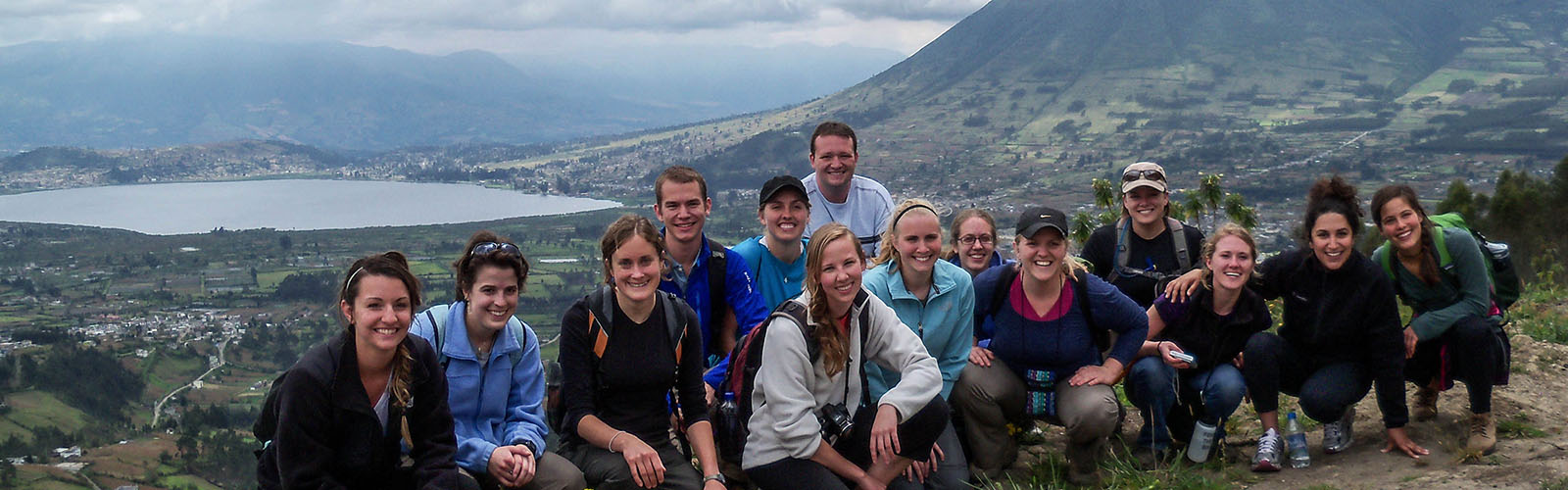
The Global Health Field Course in Ecuador provides a powerful opportunity to look at health, wellness and healthcare through multiple lens and across multiple ethnic populations in a uniquely beautiful country. It deeply examines the relationships between cultural beliefs/practices and people’s understanding of health and disease, choices for care (including alternative therapies such as medicinal plants), and access to care, as well as how interactions with animals impact human health, well-being and disease. The latter incorporates the “One Health” concept that the health of humans, animals, and their shared ecosystems are interdependent on one another. Students will be immersed in these issues across both indigenous and mestizo populations through nearly daily field trips, visits to healthcare facilities of different kinds and deep discussions. Students will be expected to use these experiences to further build their own views on the meanings of health and the pros and cons of global healthcare systems.
Dr. Frank Hutchins, Professor at Bellarmine University and a renowned medical anthropologist with extensive experience in Ecuador will lead the program. Healthcare faculty from UW-Madison will serve as additional program leaders in Ecuador.
Exhibit integration of contextually-grounded information about how Ecuador's history, politics, culture, race, economics, environment and indigenous knowledge inform your understanding of health
Exhibit recognition of the importance of cultural norms in understanding health and wellness issues in this international health setting, and develop an understanding of "intercultural health"
Demonstrate understanding of the connections between human/animal/ecosystem health and disease
Compare and contrast how healthcare is provided in different settings in Ecuador to healthcare delivery in another country for which you have knowledge/experience
Demonstrate effective communication and collaboration across the different health education disciplines represented to achieve shared goals for the group
Model ethical behavior in community-based engagement, including appreciation of the bidirectional nature of learning and mutual benefits between community members and students, cultural humility and flexibility, and openness to new information/ideas
Diversity & Inclusion
We are committed to providing quality study abroad and domestic study away programs for every UW-Madison student. We work strategically to identify, address, and remove barriers that may prevent participation and to provide a welcoming and inclusive environment for students. Our staff actively engages with students, faculty, and staff from diverse backgrounds and prioritizes the continuous development of our knowledge and cultural competence. We also recognize the importance of increasing access to study abroad for historically underrepresented student populations. We are committed to diversity and inclusion so that every student can engage with and understand their identity through a new lens and continue to develop and make progress on their personal, professional, and academic goals.
Sustainability
We recognize that the future of study abroad, domestic study away, and international internship programming requires a Commitment to Sustainability. We are devoted to examining, developing, and improving sustainability in all our endeavors, aligning with campus priorities and following through with UW-Madison's climate action and Resilience Commitment. Join our efforts and learn more about how to study abroad sustainably.
Request Information
Join our email list to receive program updates-including application notices, scholarship information, and more!
Eligibility
Open to Medicine, Nursing, Pharmacy, Veterinary Medicine, Graduate, Capstone students, and Junior and Senior Undergraduates on a space available basis. Preference is given to students in Health Sciences and to Graduate students.
Graduate students/ Dissertators need to be in good academic standing. Undergraduate students require a 2.0 cumulative GPA.
Open to UW-Madison degree-seeking students and all degree-seeking students at a US college or university. Preference is given to UW-Madison students.
Participants are required to take Publ Hlth 714 (2 cr) during the Spring semester prior to the program. Once admitted to the program, participants will get permission to register for the prep course.
At the time of application and the semester prior to participation, UW-Madison students must be currently enrolled. Transfer Students to UW-Madison need to be currently enrolled at their home institution
Advising Location
Program Structure
UW Signature
Subjects
Public Health, Medicine, Veterinary Medicine, Pharmacy, Anthropology
In this truly interdisciplinary setting, you will think critically about connections between cultural variables and human and animal health and disease, gain firsthand experience with cultural and medical issues in a developing country, and will develop an understanding of the theoretical and empirical foundations of medical anthropology. The course is designed so you will develop cross-cultural skills that will ideally grow into personal and professional assets for future healthcare practice. Throughout the course, the class will consider how biological/scientific approaches to health can intersect or conflict with more culturally-based approaches and will engage in such questions as: how can a cultural understanding of the body and its various conditions improve the understanding and delivery of healthcare?
The program also includes an excursion to the Upper Amazon and homestays in a rural community.
During the spring semester preceding the field program, you are required to take Publ Hlth 714 (2 cr). Once accepted to the program, you will receive notification that you have been granted permission to enroll in the relevant section of the prep course. The preparatory course addresses such topics as the health care system in Ecuador, public health management in Ecuador, rural health training and research, rural health development, and health system management issues.
You will earn 2 UW-Madison credits upon successful completion of the in-country program.
These students will earn credit for Public Health 716, a course that uses Sat/Unsat grading: • Graduate/professional and capstone certificates students who are using the credit to fulfill certificate requirements • MEDS who are not using the credit to fulfill certificate requirements
All other students will earn credit for Study Abroad 545: Topics in Social and Natural Science, which uses A-F grading.
A full course syllabus and schedule will be provided by your Program Leaders.
Use the links below to see a list of courses that past students have taken
on this program and the UW equivalents. Note: This list only includes
pre-approved courses for your program and may not be an exhaustive list of
courses, departments or equivalents. Courses may not be available the
semester you are abroad. You will receive instructions on the course
equivalent process after acceptance.
View Course Equivalents
Ecuador is located on the northwestern coast of South America along the Pacific Ocean, sharing borders with Colombia and Peru. Recognized throughout the world for its immense biodiversity, Ecuador is divided into three regions: the Costa (coast), Sierra (mountains), and Oriente (east [Amazonian region]), plus the Galápagos Islands (known locally as the Archipiélago de Colón). The continental regions extend the length of the country from north to south and are separated by the Andes Mountains. Ecuador has a long tradition of quality higher education, dating back to the 17th century.
Check out the program locations Quito and Otavalo on a map! with a several-day excursion to the Amazon as well as additional excursions.
Otavalo is a largely Indigenous town in Imbabura Province, Ecuador. The town is located in a valley, surrounded by the peaks of three volcanoes. Otavalo is famous for its textiles, and although its primary market day is Saturday, there are wares available for tourists throughout the week in the Plaza del Poncho in Otavalo. Tourism is now the town's main industry and as a result many hotels have been set up in colonial buildings along with a number of restaurants. Otavalo is also known for its Inca-influenced traditional music and musicians.
Geographically, Ecuador lies in a hot zone, but due to the snow-capped mountains of the Andes and the cold currents running through the Pacific near the coast, considerable variations occur. Nevertheless, there are three distinct climactic regions: the hot coast and jungle areas, the warm semi-tropical regions, and the cool highlands, which are moderately warm in the dry season. Most of the course will take place in the highlands regions, with excursions elsewhere.
Cost of living varies widely by location. Be sure to consult a variety of resources when researching cost of living.
Housing
Housing in guesthouses and with local hosts is included for the duration of the program. During orientation in Quito and throughout most of the time in the Otavalo area, students will stay in a local hotel, but there will also be homestays for several nights. Dietary preferences of students usually can be accommodated if made clear in advance.
We typically place students in rooms with others of the same sex. In some locations, this is necessary for legal or cultural reasons. We understand that not all students may identify as female or male, and we want to create a welcoming environment for you while you are abroad. We are happy to work with students who identify as transgender, genderqueer, gender non-conforming, and/or non-binary regarding life abroad. If you have questions or concerns regarding housing as it relates to your gender identity, please contact your Study Abroad Advisor.
Program Considerations
In a physical sense, the on-site experience may be very different from life on the UW campus. You may walk or take public transportation more than you are used to in Madison. The physical activity level will vary by program, but in general you should be prepared for extended periods of time walking, potentially on uneven terrain.
For many students, discovering and experiencing new foods is a part of the experience. It is important to consider any dietary restrictions, whether they are due to health conditions, religious beliefs, or individual needs, and look into whether you can get the foods you need locally.
How you identify yourself in Madison may differ from how people will view you on-site. Consider exploring our Identity Resources to reflect on how your identities may impact your experience. Students with disabilities should keep in mind that attitudes and laws related to disabilities vary by country, and these differences may impact the level of accommodation available in a particular location. More details are available on our page on Study Abroad for Students with Disabilities.
We encourage you to contact your Study Abroad Advisor and share your accommodation needs with us as early as possible. This will allow us to help you explore your options in advance.
Excursions and Activities
You will get to experience various locations and communities in Ecuador during this program, including a several-day excursion into the Amazon. You will visit clinics and health centers and will participate in community-based activities. Excursions will include cultural events and visits to scenic natural areas. Past site visits have included an animal market, local healers, clinics, and indigenous communities.
On-Site Support
Program Leaders from UW-Madison and Bellarmine University provide on-site support for the duration of the program.
Orientation
IAP expects you to be an active participant in preparing yourself for your study abroad experience. As a participant on an IAP program, you will receive a pre-departure orientation, either in-person or online. The type and format of this orientation will vary by program and will be provided to you upon acceptance to the program.
There will also be an on-site orientation upon arrival in Ecuador.
Visa
A visa is not required for U.S. citizens for this program. U.S. citizens must have a U.S. passport valid for at least six months beyond the end of the program. Non U.S. Passport holders may have different visa requirements. Ask your Study Abroad Advisor if you have any questions.
Students staying in Ecuador beyond the program dates should consult the Ecuador Embassy, particularly if your visit exceeds 90 days.
Getting to Your Program
You make your own travel arrangements but will be given guidelines for arrival dates and times.
In-country program travel, including transportation to/from the Amazon via domestic air, is arranged for participants and included in the program fee.
Insurance
You will be enrolled in the UW System required health insurance through Cultural Insurance Services International (CISI) and the cost of the insurance coverage is included in program fees.
If you are a citizen of a country other than the United States and will remain/study in, or travel to your country of record (the location of your permanent residence), the insurance provided for you is the same as the “study away” insurance provided to U.S. citizens studying on domestic U.S. programs. You may want to explore alternative or additional international health and medical insurance that will cover your needs both while in and during any period of transit to/from your country of record. This may include participation in a national healthcare plan or coverage provided under a personal healthcare plan in your country of record. If you have questions about the coverage of the “study away” plan, please speak with your Study Abroad Advisor.
All other students participating on an international program will automatically be enrolled in Cultural Insurance Services International (CISI), the university's international health, medical and repatriation insurance policy.
Program cost information includes program fees, as well as out-of-pocket expenses with notes to help explain costs. Program fees are estimated and can be adjusted at any time. Once accepted, you will receive a cost sheet that includes confirmed program fees and additional out-of-pocket expenses. "The IAP Program Fee" and all processes and policies stated on this cost sheet apply to all participants on programs managed by International Academic Programs (IAP) and in partnership with the College of Agricultural and Life Sciences, the College of Engineering, and Wisconsin School of Business. All students participating on approved programs are all eligible to apply for scholarships administered through IAP when they meet the scholarship eligibility and selection criteria.
UW–Madison students can typically use their financial aid on UW–Madison study abroad, domestic study away, and international internship programs. You need to complete a FAFSA if you want to be eligible to receive federal and state financial aid.
Beginning in 2026-27, the Office of Student Financial Aid will require all incoming undergraduate students to submit a CSS profile.
This scholarship list includes scholarships we know are relevant to this program. It is not an exhaustive list of all available scholarship opportunities for study abroad. Although we make our best effort to ensure the list is up-to-date, this information changes frequently, and it is the responsibility of the applicant to verify information. For additional scholarship information, please visit our scholarship page.
“I have a much better understanding of how people's world views can affect their exposure to, beliefs about, and treatment of illnesses/diseases. This will be an important thing to keep in mind while treating patients from different backgrounds than mine.”
“I think there is immense value in learning about another culture and their views on health, wealth, spirituality, etc. Viewing health from the perspective of another ethnic group certainly encourages us to be more reflective and welcoming of diverse patients in our field of medicine. There is incredible value in medical students and pharmacists learning about the plants that indigenous people use to treat illness and how those compare/contrast to methods used in Western medicine. Moreover, it is invaluable that we are prompted to consider how a patient's lifestyle and daily encounters impact their health. Students will, hopefully, go back to the clinic and more regularly consider environmental and cultural factors when speaking with their patients.”
“As a medical student it was a great opportunity to get some insight into animal health, and how animal health can affect human health.”
“As a vet student, I definitely got a good amount of knowledge about how veterinary medicine is applied in Ecuador.”
“I learned very much about inter-professional relationships and what things are like for the other graduate students.”
“The perspective that I received and the culture shock I experienced was incredibly valuable to me to learn about different ways to approach health care and health disparities in the future.”
"It was wonderful to get the opportunity to explore the concepts of culture and healthcare within a developing nation and to interact directly with populations who are the subjects of health disparities."
“This experience has provided another perspective of health and medicine that encourages me to exercise more humility in my practice. There is healing value in hope (similar to the placebo effect) that should not be underestimated in clinical medicine. I hope to capitalize on this concept in my patient encounters, listening intently to the needs my patients express and instilling hope in their ability to overcome whatever ails them - whether that be a virus or mental illness or a negative spirit. Moreover, I am intrigued by our introduction to herbal medicine and am eager to learn more about the tools the public utilizes to self-treat. By expanding my scope beyond pharmaceuticals and surgeries, I may better serve my patient population.”
Students Requiring Accommodations: Consult and register with the McBurney Disability Resource Center McBurney Services if you will need academic, housing, and/or other disability-related accommodations or services abroad.
Military-Connected Students with Veteran’s Benefits: Talk with University Veteran Services about how your benefits can be used for study abroad.
This program is offered by International Academic Programs. We have a team that works with each program. Each member of this program team is able to help students with different kinds of questions. Visit the advising webpage to learn how to schedule an appointment.
Enrollment Manager
For questions on application advising, program eligibility, course equivalency request process, grade processing.
This scholarship is available to degree-seeking UW-Madison undergraduate students participating on an IAP study abroad program in Latin America. Applicants must have a 3.0 cumulative GPA and demonstrate some financial need. Scholarships range from $500-2,000.
This award was established in 1975 with a bequest from the estate of Cyril Winton Nave, a 1918 UW-Madison business graduate, and is given to students studying abroad in Latin America. Mr. Nave was the founder and director of the Atlantic Refining Company and had many dealings in Latin America.
Award Amount
$500 - $2,000
Eligibility Criteria
This scholarship is available to degree-seeking UW-Madison undergraduate students participating on an IAP program in Latin America. Applicants must have a 3.0 cumulative GPA and demonstrate some financial need.
How to Apply
This scholarship is an auto-match application. Students who submit an application for the IAP Study Abroad Conditional Application in the Wisconsin Scholarship Hub (WiSH) will be automatically considered if they meet the eligibility criteria.
Global Scholars Scholarship
Description
This scholarship is available to UW-Madison students participating in the following affiliated programs: Center for Educational Opportunity, Chancellor's & Powers Knapp Scholarship Program, First Wave, PEOPLE, or the Posse Program. The scholarship was designed to support Scholars who are engaging in study abroad or study away opportunities during the Winter Intersession and/or Summer; must be participating on an International Academic Programs (IAP) study abroad program, in partnership with CALS, Engineering, Business, & the International Internship Program (IIP).
Pending annual renewal, this scholarship is available to UW-Madison undergraduate students pursuing degrees in the School of Education who are studying abroad on an IAP program. Any School of Education undergraduate major is eligible to apply. Preference will be given to applicants for whom this would be their first study abroad experience, as well as for students on a program to Africa, Asia, or Latin America.
This award is made possible from alumni of the School of Education who share the school's value of international education.
Award Amount
$3,000
Eligibility Criteria
This scholarship is available to UW-Madison undergraduate students pursuing degrees in the School of Education who are studying abroad on an IAP program. Any School of Education undergraduate, including students in "pre" status (e.g., pre-Elementary Education, pre-Kinesiology), or students earning the Certificate in Educational Policy Studies or the Certificate in Education and Educational Services are eligible to apply. Preference will be given to applicants for whom this would be their first study abroad experience, as well as for students on a program to Africa, Asia, or Latin America.
How to Apply
Students who are eligible are automatcially considered for this award.
CALS Study Abroad Scholarships
Description
Students must have their primary academic program in CALS are eligible to apply for scholarships specifically for CALS majors. Students must apply for the Study Abroad Scholars scholarship through IAP to be considered for these awards. Students must have also completed/submitted their study abroad application in order to be considered for a CALS study abroad scholarship.
Students who are completing the Global Health Certificate, but whose majors are outside of CALS (such as L&S) are not eligible.
Award Amount
Varies ($1000-$2500)
Eligibility Criteria
Students must have their primary academic program in CALS to be eligible to apply. Students who are completing the Global Health Certificate, but whose majors are outside of CALS (such as L&S) are not eligible. Students must have also completed/submitted their study abroad application in order to be considered for a CALS scholarship.
Pending annual renewal, this scholarship is available to UW-Madison undergraduate students pursuing degrees in the School of Education who are studying abroad on an IAP program. Any School of Education undergraduate majors, including students in "pre" status (e.g., pre-Elementary Education, pre-Kinesiology) are eligible to apply. Certificate students are not eligible.
This award is made possible from Claire Shaffer who worked in the Dean's Office in the School of Education for 17 years. Claire believes that spending time overseas helps persons to more fully understand and appreciate the difference in our cultures and perspectives. Spending that much time involved in various capacities made her appreciate what UW-Madison stands for, and how it positively impacts the lives of all who study and work in the environment. She hopes that the recipient of the scholarship will fully embrace the experience the culture and opportunities that present themselves while overseas. And, hopefully, be able to travel, whenever, and wherever they get a chance.
Award Amount
$2,000
How to Apply
Students who are eligible are automatcially considered for this award.
History Department Global Perspectives Scholarship
Description
History majors at UW-Madison are eager to study and intern abroad and bring what they learn in the classroom to life. The Department of History’s Global Perspectives Scholarship hopes to make this possible for History Majors and those pursuing a Certificate in History. This scholarship provides students with financial awards starting with $1500 towards short term study abroad and intern abroad programs, $3000 towards semester programs, and $4000 towards year-long programs. The scholarship can be used toward the eligible study or intern abroad program of your choice. Award Amount
$1500-$4000
Eligibility Criteria
To be considered for the Department of History Global Perspective Scholarship, an applicant must be: 1. a full-time, degree-seeking undergraduate student at UW-Madison in good academic and disciplinary standing 2. a History Major or pursuing a Certificate in History 3. Be in the process of applying, or have already applied, to a UW-Madison Study or Intern Abroad program for Summer, Fall, Winter Intersession Spring, or Academic Year. International Internship participants must be enrolled in the Worldwide Internship Program (WIP) online course. Additional consideration will be given to:
-Members of traditionally underrepresented groups in higher education: African American, Hispanic/Latinx, American Indian, and Southeast Asian (i.e., Cambodian, Hmong, Laotian, Vietnamese) -Students with financial need (EFC of $12,000 or lower preferred) -Students from socioeconomically disadvantaged backgrounds (educational or social disadvantage, such as coming from a low-income family, an underserved rural or farming community, attending a school with a limited college preparatory curriculum, or other family circumstances that have affected your educational opportunities) -First generation college students -Students traveling abroad for the first time -Additional funding may be available for students completing internships in Africa while enrolled in the Worldwide Internship Program (WIP).
How to Apply
This scholarship is an auto-match application. Students who submit an application for the IAP Study Abroad Conditional Application in the Wisconsin Scholarship Hub (WiSH) will be automatically considered if they meet the eligibility criteria.
L&S Honors Study Abroad Grant
Description Each year, the L&S Honors Program supports Honors students intending to study abroad at a UW-Madison-approved academic study abroad program through the L&S Honors Study Abroad grants. Award Amount
$1250
Eligibility Criteria
L&S Honors student studying on an approved UW-Madison Study Abroad Program How to Apply Students can apply for this award at Wisconsin Scholarship Hub (WiSH).
Family Medicine Medical Student Global Health Travel Scholarship
Description
This scholarship is for medical students intending to enter Family Medicine who participate in the upcoming summer field schools (Guatemala, Ecuador, or Thailand service-learning experience). Please see SMPH Office of Global Health website for a full description of the field school. Award Amount
$500-$3000
Eligibility Criteria
Medical student planning a career in family medicine.
Fourth-year recipients must match into an ACGME-accredited family medicine residency program.
Phi Kappa Phi Study Abroad Grants
Description
Phi Kappa Phi Study Abroad Grants are designed to help support undergraduates as they seek knowledge and experience in their academic fields by studying abroad. Fifty $1,000 grants are awarded each year. Students do not have to be a member of Phi Kappa Phi to apply.
Award Amount
$1,000
Eligibility Criteria
1. The competition is open to Phi Kappa Phi members and nonmembers in all fields of study. 2. You must be enrolled as an undergraduate student at an institiution that has an active Phi Kappa Phi chapter. 4. You must have a cumulative grade point average (GPA) of at least a 3.75 on a 4.0 scale (3.74 GPA does not qualify). 5. You must be accepted into an accredited study abroad program before the date provided and provide the letter of acceptance as part of your application. 6. Your study abroad plan should relate directly to your academic preparation, potential career choice, or commitment to the welfare of others.
Our mission at Going is to help people travel and experience the world. Since 2017, we've helped young travelers get out there and get going. Twice a year, two outstanding students will win $1500 towards their study abroad programs. Students must be U.S. citizens or residents enrolled full-time at an accredited institution of higher learning.
Award Amount
$1,500
Eligibility Criteria
Students must be U.S. citizens or residents enrolled full-time at an accredited institution of higher learning. How to Apply
The U.S. Department of State's Benjamin A. Gilman Internatonal Scholarship is a grant program that enables students of limited financial means to study or intern abroad, thereby gaining skills critical to our national security and economic competitiveness. The Gilman Scholarship Program is open to U.S. citizen undergraduate students who are receiving Federal Pell Grant funding at a two-year or four-year college or university to participate in study and intern abroad programs worldwide.
Award Amount
Varies (up to $5,000)
Eligibility Criteria
Scholarships available for undergraduate students who receive federal Pell Grant funding. Scholarships up to $5,000 for a semester/year in addition to a possible $3,000 Critical Need Language Supplement.
The Gilman Scholarship Program aims to support a diverse range of students who have been traditionally under-represented in study abroad, including but not limited to: 1. Students with high financial need 2. Students studying in non-traditional countries, especially those outside of Western Europe, Australia and New Zealand (Note: Students may not study in a country currently on the Department of State's travel warning list) 3. Students with diverse ethnic backgrounds 4. All recipients are required to carry out a Follow-on Service Project that promotes international education and the Gilman Scholarship Program at the students' home institution or in their home community.
All applicants are strongly encouraged to contact their Study Abroad Advisor for assistance with the application essays.
Corinne Jeannine Schillings Foundation
Description
The Foundation supports Silver or Gold Award Girl Scouts undergrads who plan to study abroad, regardless of their major/minor. It is not necessary to be an Academic Scholarship recipient to apply; nor are Academic Scholarship recipients excluded from applying. Study abroad may occur during first/second/summer semester, or the full academic year.
Award Amount
$1000
Eligibility Criteria
Provide proof verifying receipt of the Silver and/or Gold Award. Submit a letter of recommendation from a Girl Scout volunteer or staff member who is not a relative. The letter of recommendation MUST be written within the past six months, specifically for this scholarship. Provide proof of acceptance to study in an accredited “study abroad” program. Show proof that the cumulative grade point is at least a “B”. ----------------------- How to Apply
Follow instructions on website for application details
Great People - International Studies Scholarship
Description
This scholarship is available to degree-seeking UW-Madison undergraduate students studying abroad on an IAP study abroad program, in partnership with CALS, Engineering, and Business. This scholarship aims to ensure that undergraduates with financial need can realize their dream of studying abroad. The Great People-International Studies Scholarship makes study abroad accessible and affordable, just as the UW Foundation’s Great People Scholarship helps to ensure that no student accepted to the university on outstanding merits will be turned away for want of money.
Award Amount
Varies
Eligibility Criteria
This scholarship is available to degree-seeking UW-Madison undergraduate students studying abroad on an IAP study abroad program.
IAP Graduate and Professional Student Study Abroad Scholarship
Description
This scholarship is available to degree-seeking UW-Madison graduate and professional students studying abroad on an IAP study abroad program, in partnership with CALS, Engineering, and Business.
Award Amount
$2,500
Eligibility Criteria
Student Eligibility Requirements: In order to be considered for this scholarship for this application round, an applicant must: 1) Be a full-time, degree-seeking graduate or professional student at UW-Madison; and 2) Submit the completed scholarship application materials online by the stated deadline. Students must be in good standing with preference being given to students who demonstrate financial need. Applicants must be in good standing at UW-Madison and have demonstrated financial need.
How to Apply
Completed applications must be submitted online by the deadline. If your study abroad program application isn't due until after this date, you must still submit your scholarship application by this date to be considered. Incomplete scholarship applications or applications submitted to the office will not be considered. To apply, please log into Wisconsin Scholarship Hub (WiSH).
Julie and Michael Gerend Scholarship
Description
This scholarship is available to degree-seeking UW-Madison undergraduates participating on an IAP study abroad program. Preference is given to Evans Scholars with a minimum 3.0 cumulative GPA. Awards range from $500 - $1,000 depending on program duration.
This award is made possible by generous donation from Julie and Michael Gerend to help provide financial support to students who wish to study abroad since their own study abroad opportunities profoundly influenced their lives.
Award Amount
$500 - $1,000
Eligibility Criteria
Degree-seeking UW-Madison undergraduate participating on an IAP program. Preference is given to Evans Scholars with a minimum 3.0 cumulative GPA.
How to Apply
This scholarship is an auto-match application. Students who submit an application for the IAP Study Abroad Conditional Application in the Wisconsin Scholarship Hub (WiSH) will be automatically considered if they meet the eligibility criteria.
Morton and Lena Wax Scholarship
Description
This scholarship is available to degree-seeking UW-Madison undergraduate students studying abroad on an IAP program.
This scholarship is made possible through the generous donation of the children of Morton and Lena Wax as a tribute to their parents and to express their appreciation for the excellent education family members have received at UW-Madison.
Award Amount
$500
Eligibility Criteria
This scholarships is available to degree-seeking UW-Madison students studying abroad on an IAP program.
How to Apply
This scholarship is an auto-match application. Students who submit an application for the IAP Study Abroad Conditional Application in the Wisconsin Scholarship Hub (WiSH) will be automatically considered if they meet the eligibility criteria.
Dorothy E. Paull Fund
Description
Pending annual renewal, this scholarship is available to degree-seeking UW-Madison undergraduate students studying abroad on an IAP study abroad program, in partnership with CALS, Engineering, and Business.
This award was established by Mrs. Paull in 1984 and is awarded to students to promote world peace via participation in study abroad programs.
Award Amount
Varies
Eligibility Criteria
This scholarship is available to degree-seeking UW-Madison undergraduate students studying aborad on an IAP study abroad program.
This scholarship is available to degree-seeking UW-Madison students participating on an IAP program, in partnership with CALS, Engineering, and Business, to Latin America. This scholarship was established by George and Lisa McReddie to make it possible for students to study abroad in this region of the world.
Award Amount
Varies
Eligibility Criteria
This scholarship is available to degree-seeking UW-Madison students participating on a study abroad program to Latin America.
How to Apply
This scholarship is an auto-match application. Students who submit an application for the IAP Study Abroad Conditional Application in the Wisconsin Scholarship Hub (WiSH) will be automatically considered if they meet the eligibility criteria.
Rothschild Study Abroad Scholarship
Description
This scholarship is open to enrolled UW-Madison Students from the greater Chicagoland area (as defined by Cook, DuPage, Kane, Lake, McHenry and Will counties) or a current recipient of one of the WAA Chicago Chapter Scholarships.
WAA Chicago Chapter created this fund circa 2005 with the estate gift from Robert Rothschild in efforts to support study abroad participants.
Award Amount
Varies
Eligibility Criteria
Must be from greater Chicago Area (as defined by Cook, DuPage, Kane, Lake, McHenry and Will counties) or a current recipient of one of the WAA Chicago Chapter Scholarships.
This scholarship is available to degree-seeking UW-Madison students participating on an IAP study abroad program. This award is made possible through generous donations from UW-Madison alumni and friends of study abroad programs. These donors value the benefits of study abroad and are committed to making this opportunity available to UW-Madison students.
Award Amount
Varies
Eligibility Criteria
This scholarship is available to degree-seeking UW-Madison students participating on an IAP study abroad program.
How to Apply
This scholarship is an auto-match application. Students who submit an application for the IAP Study Abroad Conditional Application in the Wisconsin Scholarship Hub (WiSH) will be automatically considered if they meet the eligibility criteria.
IAP Study Abroad Scholars
Description
This competitive scholarship provides students with financial awards starting at $1,500 towards the eligible study abroad program of your choice, and the chance to share your experience with the UW-Madison community upon return. Students attending any program, except the funded Global Gateway programs, in IAP, CALS, ENGR, or WSB are encouraged to apply to become a Study Abroad Scholar. Please read full scholarship details, including eligibility requirements, and considerations on the Study Abroad Scholars page.
CALS majors must apply for Study Abroad Scholars to be considered for CALS donor scholarships. Award Amount
$1,500-$8,000
Eligibility Criteria
In order to be considered for the Study Abroad Scholars scholarship for this application round, an applicant must:
Be in the process of applying, or have already applied, to an IAP study abroad program (UW Global Gateway Programs are not eligible)
Be a full-time, degree-seeking undergraduate UW-Madison student
Academic merit and financial need will be considered
Submit completed application materials online by the posted deadline
This scholarship is available for degree-seeking UW-Madison undergraduate students attending an IAP study abroad program. Applicants must demonstrate financial need (to be determined by FAFSA submission) and maintain Minnesota or Non-Resident residency. Scholarship will be awarded to students participating on a fall, spring, or year-long program. Scholarship award can range from $200-$2,000.
This scholarship was established by International Academic Programs (IAP) in order to provide assistance to students looking to expand their educational opportunities abroad.
Award Amount
Varies
Eligibility Criteria
This scholarship is available for degree-seeking UW-Madison undergraduate students attending an IAP study abroad program. Applicants must demonstrate financial need (to be determined by FAFSA submission) and maintain Minnesota or Non-Resident residency. Scholarship will be awarded to students participating on a fall, spring, or year-long program.
How to Apply
Students accepted to an approved IAP study abroad program for a semester or year are automatically considered for this scholarship if they have completed a FAFSA and submitted all necessary supplemental forms to the Office of Student Financial Aid Office. Students should submit a FAFSA as soon as possible. Funds are disbursed until exhaused for the term.
Bryan Davia Scholarship
Description
This scholarship is available to degree-seeking UW-Madison undergraduate students studying abroad on any UW-Madison study abroad program. Preferences for this scholarship include a minimum 2.75 cumulative GPA, financial need, first generation college student, and first time abroad.
The Bryan Davia Scholarship was created in his honor to commemorate his life and to continue to share his gift of enriching the lives of everyone around him. As someone who loved to explore the world and everything life had to offer, Bryan would want nothing more than to help others do the same. Bryan was a compassionate, outgoing, hard working alumni of UW-Madison who cherished his time studying abroad in Barcelona. During his time abroad, Bryan set out to discover everything his new home had to offer. Bryan possessed the ability to extract the energy of a city through the exploration of its music, nightlife, and food allowing him to fully integrate himself within his environment and it’s culture. Bryan understood the value of knowledge gained from experiences and social interactions, rather than just in a classroom. We hope the recipient of this scholarship shares his devotion to balancing hard work with an unrelenting desire to explore, discover, and enjoy every moment in their new city.
Description This funding comes from Sarah Perry, who having studied abroad for a year, wishes to support the same opportunity for students. Recipients may attend the University’s Approved Study Abroad Program of their choice (of any duration, international location, or subject matter), but may lack the necessary financial resources to do so.Award Amount
$5000
How to Apply
This scholarship is an auto-match application. Students who submit an application for the IAP Study Abroad Conditional Application in the Wisconsin Scholarship Hub (WiSH) will be automatically considered if they meet the eligibility criteria.
Study Abroad Promise Scholarship
Description
Undergraduate students who are part of a UW-Madison Promise Program (Bucky's Tuition Promise, Bucky's Pell Pathway, BANNER, Wisconsin Tribal Education Promise, and Badger Promise) are eligible for this scholarship of up to $6000 towards a faculty-led program during winter or summer. Review full eligibility on our Study Abroad Promise page.
Award Amount
$6000
Eligibility Criteria
This scholarship is open to undergraduate students who:
Will participate on a short-term faculty-led program*
Are part of a Promise Program (Bucky’s Tuition Promise, Bucky’s Pell Pathway, BANNER)
are full-time degree-seeking undergraduate students at UW-Madison.
Students participating on Global Gateway programs or have previously participated on any UW study abroad program are not eligible.
How to Apply
Eligible students will be automatically reviewed and notified of award amount prior to acceptance to program.
IAP Gilman Incentive
Description
IAP will provide a guaranteed $1000 scholarship to students applying to the Benjamin A. Gilman International Scholarship for the first time and meet the Gilman's scholarship eligibility requirements and application deadlines.
Students can only receive the IAP Gilman Incentive one time in their academic career. No additional application to IAP is needed and our staff will notify recipients after the Gilman scholarship deadline. Award Amount
$1000
How to Apply
For more information and to apply, visit the Benjamin A. Gilman International Scholarship website. No additional application is needed for the IAP Gilman Incentive award. Students can only receive the IAP Gilman Incentive one time.
IAP WISc Scholarship
Description
This scholarship was established by International Academic Programs (IAP) to assist undergraduate student participants in the Wisconsin International Scholars (WISc) Program with building their global competence and citizenship skills, which is the core goal of the WISc Program. Each WISc Scholar is eligible to receive scholarships as follows:
1) 1 scholarship of $2500 toward participation on a short-term study abroad program duration (winter intersession, spring break, or summer), and
2) 1 scholarship of $4000 toward participation on a semester program OR 1 $6000 towards a year long program.
These scholarships can be used for students attending any approved UW-Madison study abroad program.
Award Amount
$2500-$6000
Eligibility Criteria
Eligible for student participants of the Wisconsin International Scholars (WISc) Program at UW-Madison.
Social, Environmental, and Economic Development (SEED) Scholarship
Description
SEED stands for Social, Environmental and Economic Development. The Authentica SEED Scholarship is a $1,500 study abroad sustainability scholarship — $1,200 toward your program cost and a further $300 once you submit a post-program report on your project — awarded twice a year to a student who turns a real observation abroad into a practical, SDG-aligned idea. It is open to students worldwide, with any program or provider — no application fee and no minimum GPA. Award Amount
$1500 $1,200 applied toward your program cost · $300 released once you submit your post-program repor
How to Apply
For more information and to apply, visit the scholarship website.